AEO vs SEO: What Every Marketing and Creative Agency Client Needs to Know in 2026
If you have been paying attention to how search behavior has shifted over the past few years, you already know something is different. People are not just typing keywords into Google and scrolling through ten blue links anymore. They are asking full questions and expecting direct answers, instantly. That shift is exactly why the conversation around Answer Engine Optimization, or AEO, has started showing up in every serious digital strategy discussion. But here is the thing: AEO does not replace SEO. It builds on it, extends it, and in many ways, it demands more from it. Understanding how these two disciplines work together, and where they diverge, is one of the most valuable things a B2B marketing decision-maker can do right now.
Defining the Two Disciplines: SEO and AEO at Their Core
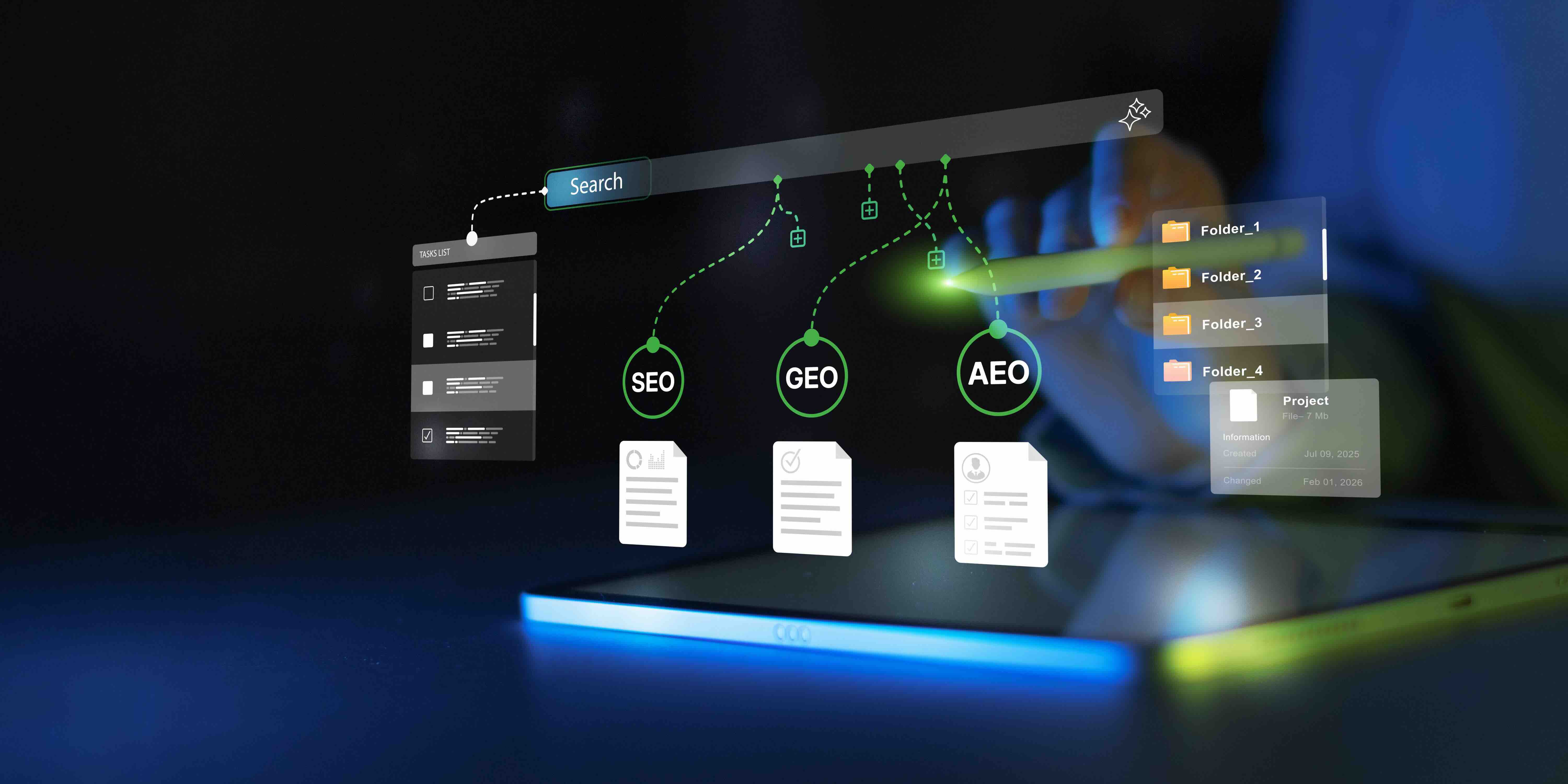
Search Engine Optimization, or SEO, is the long-established practice of improving a website's visibility in search engine results pages, commonly referred to as SERPs. It encompasses technical site architecture, keyword targeting, on-page content strategy, link authority building, and user experience signals. The goal has always been to rank higher so that more users click through to your website. AEO, or Answer Engine Optimization, takes a different angle. Instead of optimizing purely for ranking position, AEO focuses on structuring content so that search engines and AI-powered answer platforms, including Google's AI Overviews, ChatGPT, Perplexity, and voice assistants, can extract and present your content as the direct answer to a user's query. It is less about being found and more about being cited.
How SEO Works: The Foundation You Cannot Skip
Traditional SEO operates on a well-understood framework. Search engine crawlers index your site, evaluate its relevance and authority against thousands of ranking signals, and then surface it in results based on how well it matches a user's search intent. The key pillars here include technical SEO such as site speed, crawlability, and Core Web Vitals; on-page SEO including keyword placement, meta data, and content depth; and off-page SEO which covers backlink profiles and domain authority. For marketing and creative agencies specifically, SEO has historically been the mechanism that drives sustained organic traffic, supports lead generation funnels, and builds long-term brand visibility. It is not glamorous, but it is genuinely foundational. Without it, nothing else in your digital strategy holds up well.
How AEO Works: Optimizing for the Answer, Not Just the Click
AEO shifts the optimization target. Rather than asking how do I rank for this keyword, the AEO question becomes how do I become the source that gets quoted when someone asks this question. This involves structuring content in ways that AI systems and search engines can parse efficiently. That means using clear question-and-answer formatting, implementing structured data markup such as schema.org vocabulary, creating content that directly and concisely addresses specific user queries, and building topical authority through comprehensive, interconnected content. Featured snippets, knowledge panels, and AI-generated answer summaries all pull from content that has been optimized with AEO principles in mind. The shift from click-based visibility to citation-based visibility is a fundamental change in how digital authority gets measured and rewarded.
Key Advantages of AEO for Marketing and Creative Agency Clients
For B2B brands working with or operating as marketing and creative agencies, AEO offers some compelling strategic advantages that go beyond traditional traffic metrics. These are worth paying attention to because they directly affect how buyers interact with your brand during the research and consideration phases of their journey.
- Increases brand visibility in zero-click search environments where users get answers without visiting a website
- Positions your content as a trusted source cited by AI-powered platforms like Google AI Overviews and Perplexity
- Supports voice search optimization, which continues to grow in B2B research contexts
- Builds topical authority signals that also reinforce traditional SEO rankings
- Improves content structure and readability, which benefits both search engines and human readers
- Aligns content strategy with how modern buyers actually research vendors and services
Common Drawbacks and Limitations of AEO
AEO is not without its complications, and being transparent about that matters. One of the most discussed challenges is the zero-click problem. When your content gets used as the answer in an AI Overview or featured snippet, the user may get the information they need without ever visiting your website. That can reduce direct traffic even while your brand visibility increases. It is a trade-off that requires a rethinking of how you measure success. Additionally, AEO is harder to track using traditional analytics frameworks. There is no clean conversion path from an AI citation to a form submission in the same way there is from an organic click. Attribution becomes more complex. There is also the issue of AI accuracy, where answer engines occasionally misrepresent or strip context from source content, which can create brand messaging inconsistencies you did not choose. These are real considerations, not reasons to avoid AEO, but factors to plan around intelligently.
AEO vs SEO: Where They Overlap and Where They Diverge
It is worth being clear about something: AEO and SEO are not adversarial. In fact, most AEO best practices are built directly on top of a solid SEO foundation. High domain authority, quality backlinks, fast site performance, and strong on-page content signals all feed into how well your content gets selected for AI-generated answers. Where they diverge is in their primary intent. SEO is optimized for the algorithm's ranking logic, with the end goal of driving a user to your site. AEO is optimized for the algorithm's comprehension logic, with the end goal of being the most citable, quotable, and authoritative source on a topic. For agencies managing content strategy, that means evolving from keyword-first thinking to question-intent thinking, and structuring content to satisfy both goals simultaneously.
Practical Tips for Integrating AEO Into Your Existing SEO Strategy
The good news is that most agencies and their clients do not need to start from scratch. AEO integration is largely an evolution of existing SEO practices, not a replacement. The following tactical shifts can meaningfully improve your content's eligibility for answer engine citation while reinforcing your organic search performance at the same time.
- Audit your top-performing content and reformat key sections using clear question-and-answer structures
- Implement FAQ schema and HowTo schema markup where contextually appropriate
- Develop content clusters organized around specific informational queries your target audience is actively searching
- Write concise, direct answers to core questions within the first two to three sentences of each section
- Build content depth and topical breadth to signal comprehensive subject matter authority to both traditional search engines and AI platforms
- Invest in structured data implementation across service pages, blog content, and landing pages
- Monitor AI Overview appearances using search visibility tracking tools to understand where your content is being cited
Why This Matters Specifically for B2B Marketing and Creative Agency Clients
B2B buyers are thorough researchers. Before a procurement decision gets made, stakeholders are asking detailed questions across multiple sessions, devices, and platforms. In 2026, a significant portion of that research is happening through AI-assisted search, where the buyer never scrolls past the first generated answer. If your agency's content, or your own brand's content, is not structured to appear in those answers, you are losing early-funnel visibility to competitors who have invested in AEO. For creative and marketing agencies in particular, this represents an opportunity to demonstrate thought leadership at scale, building trust before a prospect ever visits your website or books a discovery call. The agencies that understand this shift and act on it now are the ones that will be disproportionately visible to future clients.
Why Kreativa Group Is the Right Partner for AEO and SEO Strategy
Navigating the intersection of AEO and SEO requires more than a content checklist. It requires a team that understands search infrastructure, content strategy, technical implementation, and business outcomes in equal measure. Kreativa Group is a marketing and creative agency headquartered in Los Angeles and Miami, with a leadership team that has managed paid media and digital strategy for multi-billion dollar brands including Newegg, Rakuten, and Fossil Group, and has delivered creative for global names like Sandals Resorts, Porsche, Audi, and BMW. They have also built and scaled startups from early growth through successful exit. To date, Kreativa Group has driven over two hundred million dollars in incremental revenue, averaged more than seven times return on ad spend, and maintained a four percent conversion rate across campaigns. They have launched more than two dozen websites across Webflow, Shopify, and WordPress, and are certified partners for Google Ads, Amazon Ads, Shopify, and Webflow, placing them among the top one percent of all US-based agencies holding those certifications. What sets Kreativa Group apart is their insistence on measuring what actually matters: business outcomes, not vanity metrics. If you are ready to build a search strategy that performs in both traditional and AI-powered environments, explore what Kreativa Group's full-service marketing and creative agency approach can do for your brand, or take the first step with a free growth audit designed to uncover your highest-impact SEO and AEO opportunities.
Frequently Asked Questions About AEO vs SEO
What is the difference between AEO and SEO?
SEO focuses on optimizing content to rank higher in search engine results pages and drive click-through traffic to a website. AEO, or Answer Engine Optimization, focuses on structuring content so that AI-powered answer engines, voice assistants, and featured snippet systems can extract and present it as a direct answer to a user's query. Both are valuable, but they serve different visibility goals.
Does AEO replace SEO in 2026?
No. AEO does not replace SEO. It extends it. A strong SEO foundation, including domain authority, technical health, and quality content, is a prerequisite for effective AEO. The two disciplines are complementary, and a well-structured digital strategy in 2026 should integrate both.
What types of content benefit most from AEO optimization?
FAQ pages, how-to guides, service explanation pages, and long-form educational content tend to benefit most from AEO optimization. These formats align naturally with how users phrase questions to AI assistants and voice search tools, making them prime candidates for featured snippets and AI Overview citations.
How does schema markup support AEO?
Schema markup, also called structured data, provides search engines and AI systems with explicit context about the content on a page. By implementing schema types such as FAQPage, HowTo, or Article, you increase the likelihood that answer engines can accurately parse and present your content in response to relevant queries.
Can AEO reduce website traffic?
It can, in some cases. When content is surfaced as a zero-click answer, users may get the information they need without visiting your site. However, increased brand citation and topical authority often compensate through improved trust signals, higher conversion rates from the traffic that does arrive, and stronger brand recall in competitive research phases.
How do I measure the success of an AEO strategy?
Traditional click-based metrics are insufficient for measuring AEO performance on their own. Effective measurement includes tracking featured snippet appearances, monitoring AI Overview citations, evaluating branded search volume growth, and assessing changes in domain authority and topical coverage over time. Brand lift and direct traffic increases can also signal AEO impact.
Is AEO relevant for B2B companies specifically?
Yes, highly relevant. B2B buyers conduct extensive research before making purchasing decisions, and a growing portion of that research happens through AI-assisted search. Being cited as the authoritative answer during early-funnel research stages builds trust and brand recognition before a prospect ever directly engages with your sales team.
How long does it take to see results from AEO efforts?
AEO results vary based on existing content quality, domain authority, and how aggressively structured data and content restructuring are implemented. Brands with a strong SEO foundation may begin seeing increased snippet and AI citation appearances within a few months of targeted AEO work. Building sustained topical authority takes longer, typically six to twelve months of consistent effort.
What role does voice search play in AEO strategy?
Voice search is one of the primary use cases AEO is designed to serve. Voice queries are typically phrased as full natural language questions, and voice assistants pull answers from content that is concisely structured around direct responses. Optimizing for voice search and optimizing for AEO are largely the same practice executed toward the same goal.
Should small to mid-size agencies invest in AEO or focus entirely on SEO first?
The most efficient approach is to pursue both simultaneously, since many AEO improvements are direct enhancements to existing SEO content. If resources are limited, prioritize technical SEO and content quality first, then layer in structured data implementation and question-intent content formatting. This sequencing builds the foundation that makes AEO efforts meaningfully more effective.