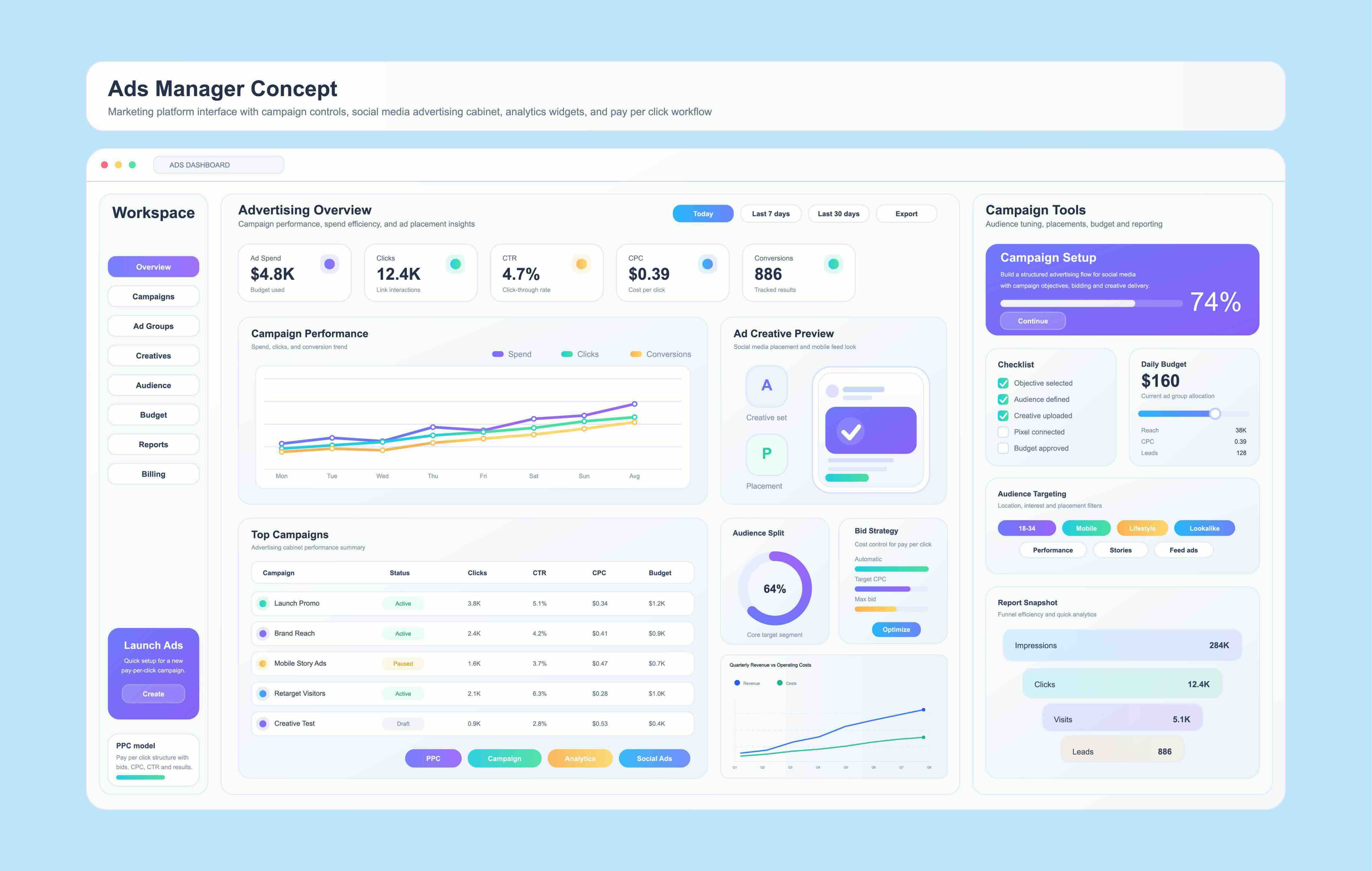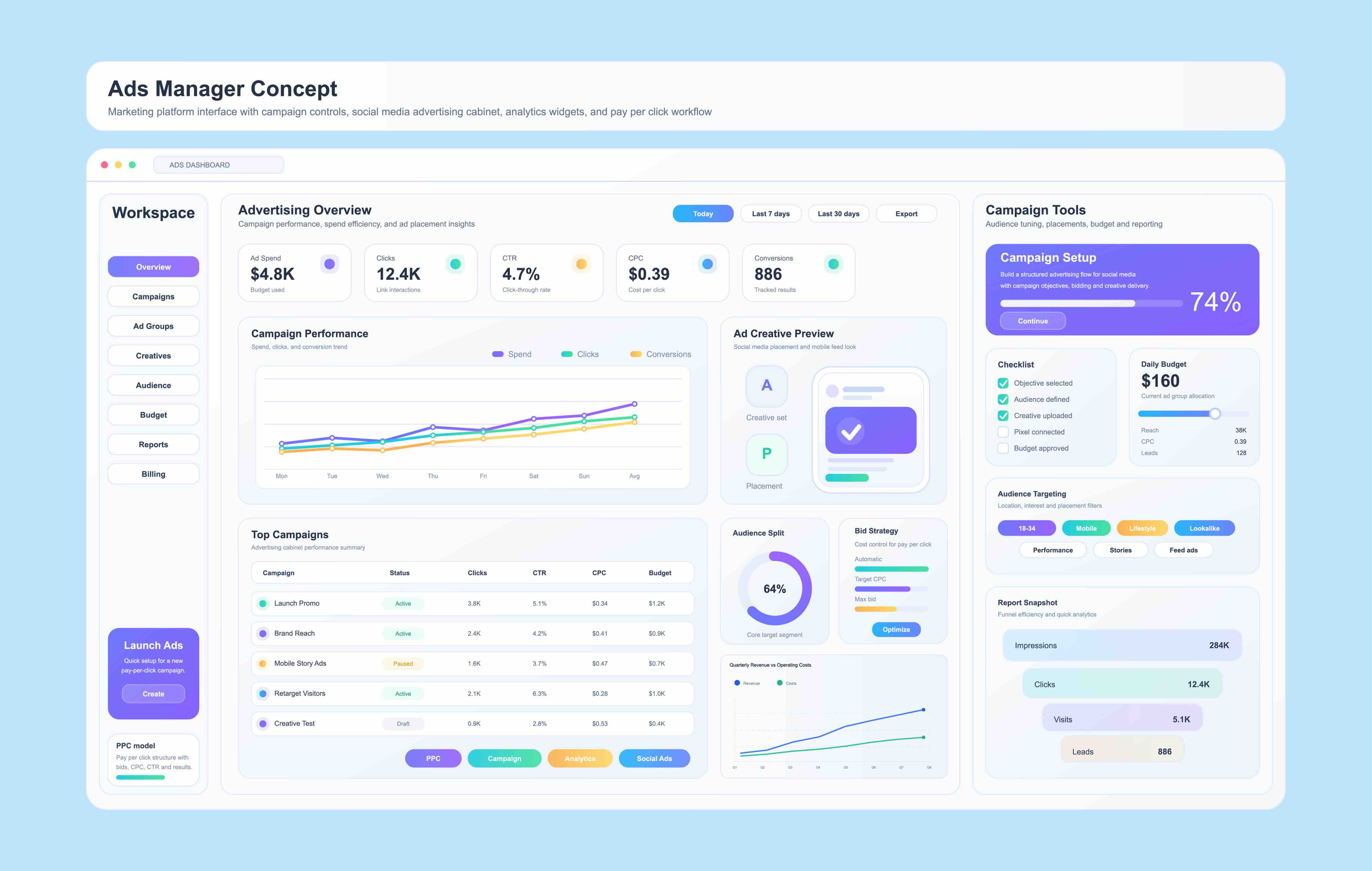
What Is PPC Reporting and Why Does It Matter for Your Business
Pay-per-click advertising moves fast. Campaigns launch, budgets shift, and results fluctuate daily. Without a disciplined reporting structure, you are essentially flying blind with someone else's money. PPC reporting is the process of collecting, organizing, and interpreting data from paid advertising campaigns across platforms like Google Ads, Microsoft Ads, Meta Ads, and Amazon Ads. The goal is not simply to track numbers but to extract actionable intelligence that informs better decisions. Done right, PPC reporting transforms raw data into a clear narrative about what is working, what is wasting budget, and where the next opportunity lives. For agencies and in-house marketing teams alike, establishing solid reporting practices is not optional. It is the foundation of every high-performing paid media program in 2026.
The Core Metrics That Actually Drive Decisions
Not all metrics deserve equal attention. One of the most common mistakes in PPC reporting is treating every available data point as equally important, which leads to bloated dashboards and confused stakeholders. The metrics that consistently drive meaningful decisions fall into a few critical categories. Performance metrics like click-through rate (CTR), cost-per-click (CPC), conversion rate, and cost-per-acquisition (CPA) tell you how efficiently your campaigns are operating. Business outcome metrics like return on ad spend (ROAS), revenue attributed to paid channels, and pipeline contribution tell you whether that efficiency is translating to actual growth. Quality metrics like impression share, search lost IS (budget), and Quality Score help diagnose structural issues before they become expensive problems. Knowing which metrics align with your specific business objectives is what separates strategic reporting from data dumping.
How Reporting Cadence Shapes Campaign Performance
Reporting frequency matters more than most teams realize. A weekly reporting cadence is typically ideal for active campaign management because it gives you enough data to identify emerging trends without overreacting to daily noise. Monthly reports are better suited for executive stakeholders who need a broader view of budget utilization and revenue impact. Quarterly reviews serve as the proper venue for strategic decisions like channel allocation, audience expansion, and creative refreshes. What you want to avoid is reporting so infrequently that optimization opportunities pass you by, or so frequently that you are chasing statistical fluctuations that have no long-term significance. The cadence should match the pace of change within the account. High-spend, high-velocity accounts need tighter reporting loops. Smaller accounts with more stable traffic patterns can afford slightly more breathing room between formal reviews.
Building a PPC Report That Stakeholders Actually Read
A technically thorough report that nobody reads is not a report. It is a document graveyard. Effective PPC reports are built with the audience in mind first, and the data second. For C-suite stakeholders, lead with business outcomes: revenue, ROAS, CPA, and period-over-period comparisons against goals. Keep this section brief and visually clean. For the marketing team and campaign managers, go deeper into campaign-level and ad group-level performance, keyword data, audience segment breakdowns, and creative performance metrics. Always include a plain-language insights section that summarizes what the data means and what actions are recommended. Numbers without interpretation are just numbers. The insights section is where your expertise shows up. It is also the section that makes the report worth reading in the first place.
Attribution Models and Why Your Reporting Depends on Getting This Right
Attribution is one of the most technically complex and frequently misunderstood aspects of PPC reporting. The attribution model you use determines how credit for a conversion is assigned across the touchpoints in a customer's journey. Last-click attribution, once the default across most platforms, overvalues the final interaction and undervalues everything that came before it. Data-driven attribution, now the recommended model in Google Ads for accounts with sufficient conversion volume, uses machine learning to distribute credit more accurately across the full conversion path. For B2B companies with long sales cycles, this distinction is especially important. A prospect might click a branded search ad weeks after first engaging with a display ad or video campaign. If your reporting model only credits the last click, you will systematically undervalue upper-funnel investment and make poor budget decisions as a result. Getting attribution right is not a reporting nicety. It is a strategic necessity.
Key Advantages of Structured PPC Reporting
When PPC reporting is done with intention and consistency, the benefits compound over time. Here is what structured reporting actually delivers for growth-focused businesses:
- Faster optimization cycles that reduce wasted spend
- Clearer alignment between paid media investment and business outcomes
- Stronger stakeholder confidence and budget approval rates
- Easier identification of underperforming segments before they drain resources
- More accurate forecasting for future campaign planning
- Accountability across agency and internal team relationships
- Data-driven justification for creative and audience testing
These are not abstract benefits. They show up in lower CPAs, higher ROAS, and marketing programs that consistently earn larger budget allocations because leadership can see the value clearly.
Common PPC Reporting Mistakes That Cost Businesses Money
Even experienced marketing teams fall into predictable reporting traps. Awareness is the first step toward avoiding them. The most costly mistake is optimizing toward the wrong conversion event, such as tracking form views instead of actual form submissions, which inflates apparent performance and obscures real CPA. Reporting on impressions and clicks without connecting them to downstream outcomes is another frequent issue, particularly in agencies that prioritize optics over outcomes. Failing to segment data by device, audience, geography, or match type leads to surface-level conclusions that miss the nuance required for meaningful optimization. Ignoring search term reports is a persistent gap that allows irrelevant clicks to quietly drain budgets. And perhaps the most systemic mistake is using inconsistent date ranges and attribution windows across reports, which makes period-over-period comparisons unreliable and misleading.
Tools and Technology That Elevate PPC Reporting in 2026
The technology landscape for PPC reporting has matured significantly. Platforms like Looker Studio (formerly Google Data Studio) allow teams to build automated, visually polished dashboards that pull live data from Google Ads, Meta, and other sources into a single view. Tools like Supermetrics, Porter Metrics, and Funnel.io serve as connectors that streamline multi-platform data aggregation, reducing the manual export-and-paste workflows that consume analyst time and introduce errors. For agencies managing multiple client accounts, white-label reporting solutions add a layer of professional presentation that reinforces credibility. The underlying principle, regardless of which tools you use, is automation wherever possible and human interpretation layered on top. Technology handles the data assembly. Strategy and expertise determine what it means.
Why Kreativa Group Delivers PPC Reporting That Moves the Business Forward
If your current PPC reporting feels like a pile of numbers without a clear story, it may be time to work with a team that treats reporting as a strategic asset rather than a deliverable checkbox. Kreativa Group is a marketing and creative agency headquartered in Los Angeles and Miami, with a leadership team that has managed paid media for multi-billion dollar brands including Newegg, Rakuten, and Fossil Group. The agency has also delivered campaigns for globally recognized names like Sandals Resorts, Porsche, and BMW, and has held senior roles at high-growth startups that reached successful exits. To date, Kreativa Group has driven over $200 million in incremental revenue, averaged over 7x ROAS, and maintained a 4% average conversion rate across client portfolios. They are certified Google Ads, Amazon Ads, Shopify, and Webflow Partner Agency, placing them in the top 1% of all US-based agencies across those credentials. What sets them apart is a consistent focus on business outcomes over vanity metrics, which means every PPC report they produce is built to answer the questions that actually matter to growth. If you want to understand what your paid media is really doing for your business, start with a conversation at Kreativa Group's website, or take the first step by requesting a free growth audit to see exactly where your current campaigns stand.
Frequently Asked Questions About PPC Reporting Best Practices
What should be included in a standard PPC report?
A standard PPC report should include key performance metrics such as impressions, clicks, CTR, CPC, conversions, CPA, and ROAS. It should also include period-over-period comparisons, campaign and ad group-level breakdowns, budget utilization, and a written insights section that summarizes findings and recommends next steps.
How often should PPC reports be generated?
Most active accounts benefit from weekly reporting for campaign optimization purposes and monthly reporting for stakeholder reviews. Quarterly reports are appropriate for strategic planning conversations around budget allocation and channel strategy.
What is the best attribution model for PPC reporting?
Data-driven attribution is the recommended model for most accounts in 2026, as it distributes conversion credit across all touchpoints using machine learning. For accounts with lower conversion volume, position-based or linear attribution models offer a reasonable alternative to last-click.
What is ROAS and why does it matter in PPC reporting?
ROAS stands for return on ad spend. It measures how much revenue is generated for every dollar spent on paid advertising. It is one of the most important business outcome metrics in PPC reporting because it directly reflects the efficiency and profitability of your paid media investment.
How do you avoid vanity metrics in PPC reporting?
Focus your reporting on metrics that connect directly to business outcomes, such as conversions, CPA, ROAS, and revenue. Impressions and clicks have value as diagnostic signals but should not be used as primary indicators of campaign success without connecting them to downstream performance data.
What tools are commonly used for PPC reporting?
Looker Studio, Supermetrics, Funnel.io, and Porter Metrics are among the most widely used tools for PPC reporting in 2026. These platforms allow teams to aggregate data from multiple advertising channels into unified dashboards and automate report delivery.
Why is segmentation important in PPC reporting?
Segmentation allows you to isolate performance differences across devices, geographies, audiences, match types, and time of day. Without segmentation, campaign data averages out in ways that hide both problems and opportunities that would otherwise drive meaningful optimization decisions.
How should a PPC report be structured for executive stakeholders?
Executive-facing PPC reports should lead with high-level business metrics such as revenue, ROAS, and CPA, presented in a visually clean format with clear period-over-period context. Supporting detail and tactical breakdowns should be available but positioned as supplementary material rather than the primary focus.
What is impression share and how does it appear in PPC reporting?
Impression share is the percentage of total eligible impressions your ads actually received. It is a valuable diagnostic metric in PPC reporting because it reveals whether budget constraints or low Quality Scores are limiting your campaign's reach, allowing you to prioritize the right corrective action.
Can PPC reporting help improve future campaign planning?
Yes, historical PPC report data is one of the most reliable inputs for future campaign planning. Performance trends, seasonal patterns, audience segment behavior, and creative fatigue signals all emerge through consistent reporting and directly inform how budgets should be allocated and how campaigns should be structured going forward.